How to Write a Resume That Gets Noticed by Recruiters (2026 Guide)
Stop Writing an Autobiography. Craft a Targeted, ATS-Friendly Professional Advertisement That Lands Interviews.

Discover how to write a resume that gets noticed by recruiters in seconds. Learn essential ATS formatting rules, 7 proven ways to stand out, impact-driven bullet points, and how SimplyJob accelerates your job search.
Executive Briefing
Key Strategic Takeaways for 2026
Your Resume is an Advertisement, Not an Autobiography: Share only what the recruiter needs to know to envision you solving their business problems.
Think Like a Recruiter: Recruiters scan hundreds of profiles daily. A clean, scan-friendly layout wins over dense blocks of descriptive text every single time.
Show Contribution, Not Just Duties: Ditch passive phrases like "worked on content." Instead, clearly state what you executed and the measurable results you delivered.
Separate Hard Skills from Soft Skills: List technical hard skills directly in your skills section; demonstrate soft skills (communication, leadership) through real project stories.
Quantify Your Impact with Numbers: Use strong action verbs (launched, increased, reduced) and include tangible percentages, revenue growth, or hours saved.
Tailor for ATS & Humans Alike: Align keywords directly with the job description to pass Applicant Tracking Systems while keeping prose natural and engaging.
The Core Mindset: Your Resume is an Ad, Not Your Autobiography
When writing a resume, the single biggest mistake job seekers make is attempting to recount the entire story of their professional life. We all have extensive histories, courses, and daily tasks we feel proud of—but your resume is not the place to write your memoirs.
The golden rule is straightforward: your resume shouldn’t tell your entire life story.
Instead, think of your resume simply as a high-converting product advertisement:
A great ad doesn't reveal every obscure engineering detail about a product.
It highlights the exact, high-impact features that compel the buyer to take the next step.
Your resume should accomplish the exact same objective. Its singular purpose is to show the recruiter who you are, what you excel at, what tangible value you bring, and how the company benefits from having you on board.
Think Like a Busy Recruiter
Imagine sitting in a recruiter’s chair. You have a stack of 300+ resumes for a single opening, an overflowing inbox, and back-to-back screening calls. You cannot read every single line of every page. Instead, you quickly skim each resume for 6 to 7 seconds, hunting for relevant skills, recent experience, and signs of real capability.
That is why even talented candidates get overlooked every day. A great resume is not about packing maximum information onto a page—it is about highlighting the right points quickly, cleanly, and unmistakably.
What is a Resume? (And Resume vs. CV Explained)
At its essence, a resume is your professional introduction. Within just a few seconds of scanning, it should give any hiring manager a clear picture of:
What you do professionally
What core competencies you excel at
What relevant experience and accomplishments you possess
Why you are the right fit for this specific job opening
Resume vs. Curriculum Vitae (CV): What is the Difference?
Many job applicants use the terms "Resume" and "CV" interchangeably, but they serve distinct purposes:
Curriculum Vitae (CV): A comprehensive, multi-page record detailing your full academic background, publications, research projects, degrees, and full chronological career history. CVs are customary in academic, scientific, medical, and research environments.
Resume: A concise, targeted 1- to 2-page document focusing strictly on the skills, projects, and work experience most directly relevant to the target job role.
When applying for corporate, startup, tech, creative, or business positions, recruiters expect a concise, punchy resume that gets straight to the point.
Visual Blueprint: How to Write a Resume That Gets Noticed
Here is a complete visual breakdown crafted by SimplyJob’s career team, summarizing what recruiters scan for, seven proven strategies to stand out, proper formatting rules, and your pre-application checklist:
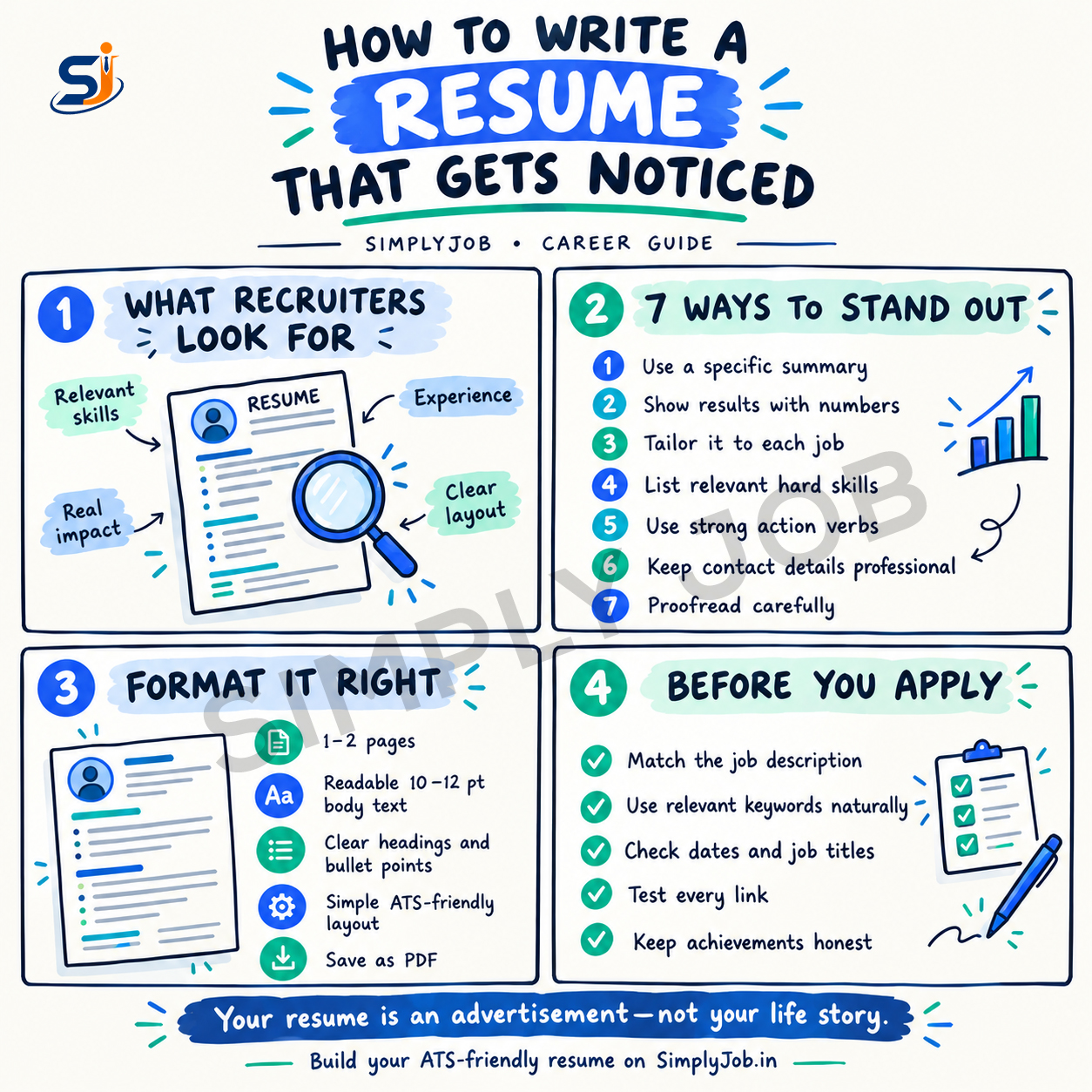
SimplyJob Career Guide: How to Write a Resume That Gets Noticed by Recruiters - Infographic on Recruiter Scanning, 7 Ways to Stand Out, and ATS Formatting Rules
Let’s dive into each actionable technique you need to apply today.
The 7 Golden Rules to Make Your Resume Stand Out
Applying these seven practical guidelines will instantly elevate your resume above 90% of competing applicants:
1. Don’t Start with a Generic Objective — Clearly Introduce Yourself
You have likely seen outdated objective statements like this: "Seeking a challenging position in a growing company where I can utilize my skills and contribute to organizational success…"
It sounds formal, but recruiters read right past it because it contains zero meaningful information. It says what you want from the company, rather than what you can offer.
Do This Instead: Open with a sharp, 2-line professional summary that defines your specialty and scope: "Junior Content Writer with 2+ years of experience crafting SEO blogs, social media campaigns, and high-converting landing page copy. Passionate about scaling organic traffic for B2B tech brands."
It is simple, specific, and gives the recruiter an immediate reason to keep reading.
2. Don’t Just List Responsibilities — Demonstrate Your Actual Contribution
Avoid passive, vague bullet points such as:
"Managed Instagram account."
"Worked on content creation."
These bullet points fail to explain your actual scope or what you mastered.
Do This Instead: Clearly describe the work you executed and what you learned or produced:
"Planned weekly content calendars, created and scheduled 15+ weekly posts for the community page, and wrote engaging captions that grew follower engagement by 35%."
The goal is simple: don’t just name the generic task—show exactly what you did.
3. Don’t List Hard Skills and Soft Skills the Same Way
Both technical hard skills and interpersonal soft skills are vital, but presenting them identically in a bulleted list weakens their credibility:
Hard Skills (SEO, Canva, Python, SQL, Excel, Video Editing): These belong in a clean, categorized Skills Section where ATS parsers and recruiters can spot them at a glance.
Soft Skills (Communication, Teamwork, Problem Solving, Leadership): Anyone can write "Excellent communication skills" on paper. Instead, demonstrate them through your experience.
For example, write: "Collaborated cross-functionally with 4 creative designers and external client stakeholders to plan and deliver multi-channel marketing campaigns on time." This makes your capability real and verifiable.
4. Don’t Add Unnecessary Personal Details — Keep Your Contact Section Lean
Your contact section should never occupy a third of your resume’s prime real estate. Avoid listing your full home address, marital status, religion, father’s name, or date of birth.
Do This Instead: Include only the essentials:
Full Name (Prominent heading)
Professional Email (e.g., yourname@email.com)
Active Phone Number
Location (City, State / Country)
Clean LinkedIn URL & Portfolio / GitHub link
Ensure every hyperlink is live and clickable. If you are applying for creative, design, or engineering roles, a working portfolio or repository link is often the single most persuasive asset on your page.
5. Don’t Be Vague — Highlight Real Results Using Numbers & Action Verbs
Recruiters crave measurable proof of impact. When you describe your past roles, anchor your achievements around tangible metrics:
Revenue or growth generated
Costs, time, or manual hours saved
Projects delivered or campaigns executed
Team members trained or collaborated with
Lead your bullet points with high-energy action verbs: Launched, Engineered, Led, Streamlined, Increased, Reduced, Created, Accelerated.
Weak: "Responsible for managing email marketing campaigns."
Strong: "Launched targeted customer onboarding email sequences that increased click-through rates by 24% and reduced churn."
6. Never Skip a Systematic Proofreading Review
Your resume does not need to be an artistic masterpiece, but typos, broken links, or sloppy formatting instantly signal a lack of attention to detail.
Before hitting send, run through this quick audit:
Check spelling and grammar (watch out for commonly confused words).
Confirm accurate employment and graduation dates.
Double-check company names and formal job titles.
Test every single link (LinkedIn, Portfolio, GitHub).
Ensure consistent bullet points, font styles, and margins throughout.
7. Don’t Send the Same Generic Resume Everywhere — Tailor for Each Role
Blasting the identical resume to 100 random job postings is one of the least effective job search strategies. While you do not need to rewrite your resume from scratch every time, you must customize it for the position:
Read the target job description carefully.
Identify the top 3-5 core competencies and technical keywords the employer emphasizes.
Align your resume summary, skills list, and relevant bullet points to reflect those exact proficiencies.
Keep keyword usage natural: write for human recruiters first, while ensuring compatibility with automated ATS parsers.
How to Format Your Resume for Maximum Readability & ATS Compliance
Recruiters often review resumes across different devices—laptops, tablets, and smartphones. Clean formatting ensures your qualifications shine without visual friction:
Length: Stick to 1 page for freshers and early-career professionals (under 5 years of experience). Experienced professionals with 6+ years can use 2 pages. Avoid 3+ pages unless applying for senior executive or academic roles.
Typography: Set body text between 10pt and 12pt, and section headings between 14pt and 16pt. Use standard, professional fonts (such as Inter, Robot, Arial, Calibri, or Helvetica).
Margins & Spacing: Maintain 0.75-inch to 1-inch margins on all four sides to prevent the page from feeling cramped.
Bullet Points: Use concise, 1- to 2-line bullet points instead of dense text paragraphs.
File Format: Always save and upload your resume as a clean PDF, unless a job posting explicitly asks for a Word document (.docx). A PDF preserves your typography and layout across all operating systems.
Keep it Clean: Steer clear of complicated multi-column tables, skill rating progress bars (e.g., "Photoshop: 4/5 stars"), or embedded graphic icons that break automated ATS parsers.
How SimplyJob Makes Building a Winning Resume Effortless
Crafting an ATS-compliant resume and customizing it for every application used to take hours of tedious formatting in word processors. SimplyJob was built to remove that frustration entirely:
100% Free Interactive ATS Resume Builder: SimplyJob provides candidate tooling built directly into the platform. Choose recruiter-tested layouts, input your experience, and watch your resume format itself into clean, ATS-compliant syntax with zero paywalls.
Real-Time ATS Parsing Feedback: Test your resume score before applying. SimplyJob evaluates your formatting, keyword distribution, and section hierarchy, ensuring your document passes automated screening bots.
One-Click Applications to Verified Employers: Once your resume is built, apply directly to thousands of verified companies and top start-ups across India. No third-party ad loops or commission brokers.
100% Scam-Shielded Career Ecosystem: Every employer and vacancy on SimplyJob is verified. We enforce a strict zero-tolerance policy against fake recruiters demanding registration charges or interview training fees.
Real-Time Application Status Tracking: Never wonder whether your resume fell into a black hole. Track your progress live from Profile Shortlisted to Interview Round and formal Offer Letter.
Final Thoughts: Make Your Value Obvious
Your resume does not need to tell your entire professional journey. It does not need to prove that you have done everything under the sun.
It needs to make the right things easy to see.
Show what you can do. Highlight what is relevant. Use real examples. Back up your claims with tangible results when you have them. Keep the design simple and readable. Eliminate whatever does not directly add value.
Most importantly, stop treating your resume like an autobiography. Treat it like an advertisement.
The goal of your resume is not to tell the recruiter everything about you. The goal is to make them eager to interview you and learn more.
“Stop treating your resume like an autobiography. Treat it like an advertisement. A good ad does not reveal every single detail about a product; it highlights the exact features that compel you to take the next step.”— Sabhiha, Content Writer, Bhatt Square Pvt. Ltd.
Frequently Asked Questions
What is the key difference between a resume and a CV?
To catch a recruiter's eye in 6 seconds: use a clean ATS-friendly layout, replace generic objective statements with a specific 2-line professional summary, emphasize measurable achievements with numbers and action verbs, and tailor your core skills to the job description.
Why should I avoid writing a generic resume objective?
Generic objectives like "seeking a challenging role to grow my skills" focus on what you want from the employer rather than what value you bring. Modern recruiters prefer a crisp Professional Summary that outlines your core expertise, years of experience, and key accomplishments.
How do Applicant Tracking Systems (ATS) scan resumes?
ATS software scans resumes for clear heading structures, readable fonts, and relevant keywords matched to the job description. Complex graphic elements, text boxes, and skill rating bars often cause parsing errors, which is why clean, standard formatting is crucial.
How does SimplyJob help job seekers create an ATS-friendly resume?
SimplyJob offers a 100% free built-in ATS Resume Builder that automatically formats your career history according to global parsing standards. It provides real-time ATS compliance scoring and lets you apply directly to verified, scam-free jobs with one click.
What are the best action verbs to use in resume bullet points?
High-impact action verbs include: Launched, Engineered, Spearheaded, Streamlined, Increased, Reduced, Delivered, Automated, and Managed. Always follow your action verb with what you did and the measurable result you achieved.
About Sabiha Arshi
Sabhiha is a Content Writer and career communication specialist at Bhatt Square Pvt. Ltd., writing for SimplyJob—a project of Bhatt Square Pvt. Ltd. She crafts actionable career guides, ATS resume strategies, and workplace insights to help job seekers stand out to top recruiters and hiring teams.
Ready to upgrade your career or hiring workflow?
Create your ATS-compliant resume for free or post your company's vacancy to reach thousands of verified candidates across India.